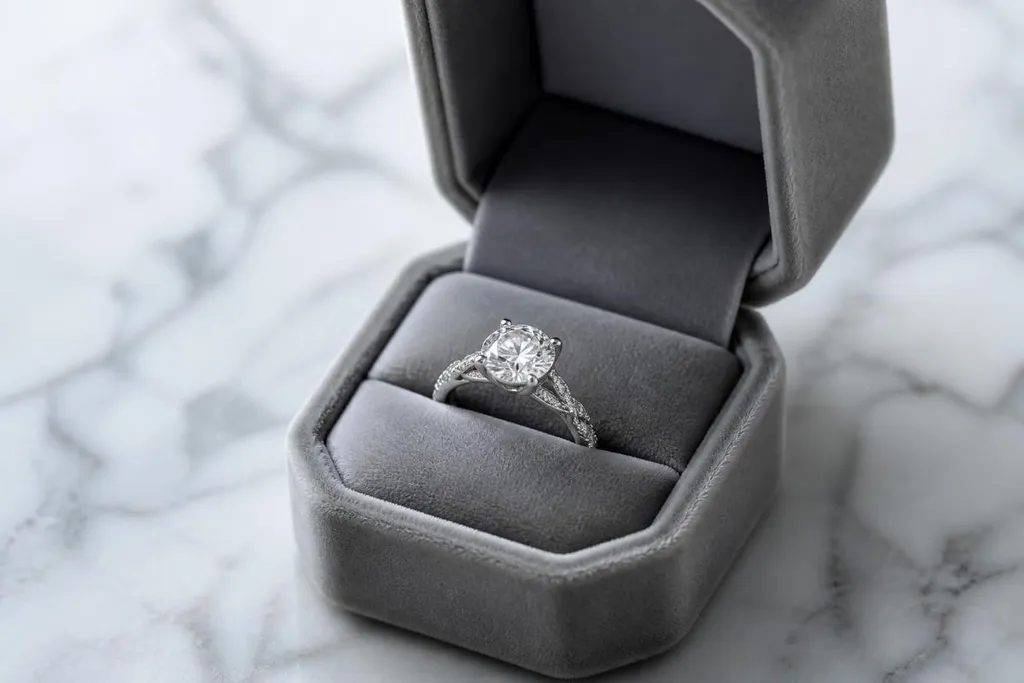
A straight engagement-ring band creates a clean, predictable line towards the centre stone. A twisted band does something quite different. Its interlacing form introduces movement through the shoulders, while micro-pavé diamonds add fine flashes of light as the ring changes angle. The combination can make a familiar solitaire feel more distinctive without relying on a large halo or heavily embellished setting. With a refined 1.90mm width, the effect can remain delicate despite the additional detail.
For someone looking to introduce more character into the shank, this upgrade offers an alternative to conventional straight pavé shoulders. Its appeal comes from combining two design elements—twisting metal and fine diamond setting—so the band contributes texture and movement while still directing attention towards the centre stone.
Why a Twist Changes the Character of the Ring
The shape of the band influences how the eye travels across an engagement ring.
Straight shoulders create symmetry and tend to place immediate emphasis on the centre. A twist introduces curved, crossing lines instead, giving the design a softer sense of movement. As those lines approach the centre setting, they can make the transition from band to diamond feel more fluid.
This is particularly effective for someone who likes the simplicity of a solitaire but finds a completely plain shank too restrained. The twist provides decoration through form rather than through additional large gemstones.
It can also introduce a subtle romantic quality. Intertwining bands are often associated visually with connection and continuity, although the design does not need an explicit symbolic meaning to be attractive. At 1.90mm, a carefully proportioned band can maintain a fine appearance on the finger. The objective is not to make the shank look heavier, but to give a relatively slender area more visual interest.
How Micro-Pavé Enhances the Movement
Micro-pavé works particularly well with a twisted profile because the diamonds do not all face the viewer at precisely the same angle.As the band curves, individual stones interact with light differently. This creates changing points of brilliance rather than one completely static line of sparkle.
The scale of the pavé is important. Very small diamonds can follow the curves of the band more naturally, preserving the definition of the twist instead of making the shoulders appear overly crowded.
Depending on the design, polished metal may remain visible alongside the diamond-set section. This contrast can make the twisting construction easier to appreciate. One surface provides brilliance while another defines the underlying shape. The result is more textural than a standard straight pavé band. Instead of simply adding diamonds to the shank, the setting uses those diamonds to emphasise its movement.
Balancing the Band With the Centre Stone
A detailed band needs to remain proportionate to the centre setting.
A larger diamond can provide enough visual weight to sit comfortably above twisted micro-pavé shoulders. Someone choosing a 2-carat centre, for example, may appreciate the additional band detail because it creates a more gradual visual transition towards a substantial stone. The decision is about balance rather than simply maximising sparkle. A smaller centre can work equally well when the twist remains fine. In this case, restrained micro-pavé helps prevent the shoulders from becoming more visually prominent than the main stone.
Shape also changes the effect. Round diamonds provide a symmetrical focal point above the flowing band, while ovals and pears continue the sense of movement through their elongated outlines. Emerald or radiant cuts can create an appealing contrast between a structured centre and softer twisting shoulders. Metal colour adds another variable. Platinum or white gold can blend closely with colourless pavé diamonds, while yellow or rose gold makes the underlying twist more visible through warm-metal contrast.
Everyday Wear and Bridal Pairing
The additional contours and small diamond settings of a twist micro-pavé band deserve thoughtful care.
Soap and hand cream can collect around the crossing surfaces and between small stones, reducing their brilliance. Gentle regular cleaning helps maintain both the sparkle and definition of the twisted profile.
Professional inspections are also useful for checking the fine pavé settings, particularly after a significant knock. Removing the ring during heavy manual activities can reduce avoidable wear.
Wedding-band pairing should be considered before completing the bridal set. Because a twisted engagement-ring shank has more movement than a straight band, a simple wedding ring can provide attractive visual contrast. A shaped or diamond-set band may create a more elaborate combination where the engagement-ring setting requires additional clearance.
Comfort and spacing should ultimately guide the choice as much as appearance.
Final Thought
A twist micro-pavé band transforms the shank from a supporting element into an active part of the engagement-ring design. Curved lines create movement, while small diamonds highlight those changing surfaces with finely controlled sparkle.
For someone who wants more detail than a plain or straight pavé band provides, the combination offers personality without requiring a dramatically larger setting. Its strength lies in balance: texture, brilliance and movement work together while the centre stone remains the natural focal point.